By Eleanor Skelton
When part of your identity is considered to be a sin, it’s easy to ignore how deeply it shapes who you are.
I’m bisexual and non-binary.
This means that I experience attraction to people who identify as male or female or neither.
It also means that I don’t particularly feel like a woman or a man. Some parts of me feel masculine and other parts feel feminine and sometimes I feel like an alien in my own skin.
I only discovered my sexual attraction and gender identity over the last 10 years since I left my unhealthy church.
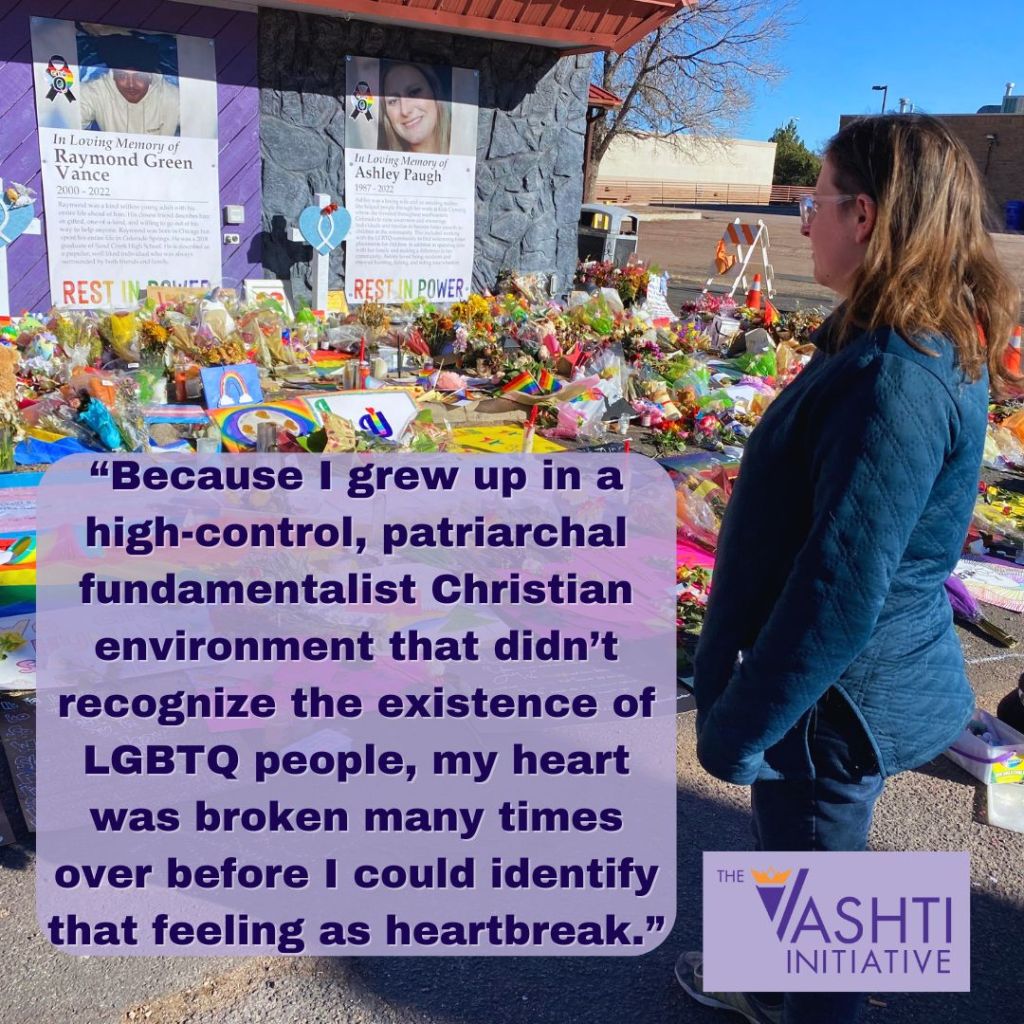
Because I grew up in a high-control, patriarchal fundamentalist Christian environment that didn’t recognize the existence of LGBTQ people, my heart was broken many times over before I could identify that feeling as heartbreak.
I didn’t know I was crushing on femme people. I was only told about people having “crushes” on guys.
I even forced myself to have a crush during 5th grade in homeschool because I thought something must be wrong with me if I didn’t have a crush on a boy by the time I was 11.
I moved out of my family’s house in 2012, after years of trying to leave home and my parents finally forcing me to leave because I wouldn’t stop attending my secular state college and transfer to Bob Jones University. I was no longer welcome at my IFB / IFCA church in Colorado Springs since moving out as an unmarried young woman was considered rebellion and therefore, a sin.
Even through the first few years of living on my own, I thought I just had some very close “best friends.”
My parents mostly limited what we were allowed to read to older literature and classics, so I assumed I just had “bosom friends” like Anne of Green Gables. But whenever a friendship that close ruptured, I was left with deeper feelings than people usually experience with the loss of a friendship. (And also people who write literary analysis have also suggested theories that Anne was actually bisexual, so there’s that.)
I don’t mean that close femme relationships are inherently sexual because that’s also not true. I’m saying that my sexual orientation is not something I can put into a box.
It shapes how I love. It impacts the depth of my relationships.
When Christians categorize a queer person existing as “sin,” it reduces a person’s way of being to an action that someone could choose to do or not. It’s like asking me as a neurodivergent human to not be autistic or ADHD.
In the aftermath of the mass shooting at Club Q in Colorado Springs in November 2022, I want to explain what it means to grow up as a queer Christian fundamentalist homeschooled kid living in this city.
Colorado Springs is a complicated community with well-known evangelical Christian ministries like Focus on the Family, Compassion International, the Navigators and megachurches like New Life Church.
The hypercalvinist Sunday School teacher who taught the “Fundamentals of the Faith” class at our IFB/IFCA church during my senior year of high school even said, “Here in Colorado Springs, we live in the evangelical Mecca.”
But there’s also a pro-marijuana legalization, hippie, slam poetry community in the Springs that is usually accepting of LGBTQ people. These two sides don’t get along.
The tension in the city is obvious, sometimes boiling over into disputes during city council meetings or small protests. Other times it’s subtle, like the way evangelical families going out to eat after church glance over at progressive millennials with tattoos and gauges as if they have fallen “into the ways of the world.”
In Colorado Springs, I met my first girlfriend and experienced my first heartbreak a few years after leaving my unhealthy church.
And I’m writing this to give another perspective both to those who have been deconstructing for several years and to those who are just beginning that journey.
For anyone who has recently left an IFB church or another church that did not recognize the existence of LGBT people, you might not be aware that within the LGBTQ Christian community, there are two groups of thought on the Q Christian Fellowship’s website (formerly known as the Gay Christian Network).
Side A Christians believe that God fully affirms LGBTQ identities and queer relationships are not sinful. Side B Christians believe that yes, gay people were created and born that way, but that’s not something you should act on. (Ex-gay Christians believe their entire identity is a sin, which I believe is inherently unhealthy.)
But both side A and side B Christians recognize that being LGBTQ shapes who you are.
When I’m processing grief from the loss of a close friendship, I’ve learned to ask myself if I was falling in love with that person without realizing it. This helps me understand why I feel heartbroken, even if we never had sex.
On the other hand, whenever I find myself connecting deeply to someone who is not straight and cisgender, I need to explore my feelings about that relationship and ask myself if I’m attracted to them. This helps me process and manage my emotions in a healthy way.
I want non-affirming Christians to understand that it’s just not possible to ask someone to “not be gay.” It makes about as much sense as asking someone to change the color of their eyes.
Even though it’s been over a year since the Club Q shooting, I’m still dealing with the aftermath.
That’s the first gay bar I ever went to. Club Q is only two blocks down Academy Boulevard from the first apartment I lived in after moving out.
I can’t just ignore that pain. And in the same way, I can’t turn away from how my queerness is a big part of who I am.
Podcast where I talk about Club Q:
Kitchen Table Cult: S5E3: Club Q with Eleanor and Rian – Dec. 16, 2022
Related posts I’ve written:
HuffPost: I Am The Thing That I Was Taught to Hate, published after the Pulse shooting on Jun 21, 2016
Homeschoolers Anonymous: How the Cage Crushed Me, March 6, 2015
Eleanor Skelton is a freelance journalist and educator, homeschooled kindergarten through senior year of high school within the high-demand subculture of fundamentalist Christianity during the 1990s and 2000s before completing a bachelor’s degree at the University of Colorado at Colorado Springs. Eleanor speaks about their experiences in leaving the Independent Fundamental Baptist movement to advocate for other cult survivors. They are currently enrolled in a journalism graduate program at the University of Alabama and write about deconstruction and mental health at www.eleanorskelton.com.
 The Vashti Initiative